
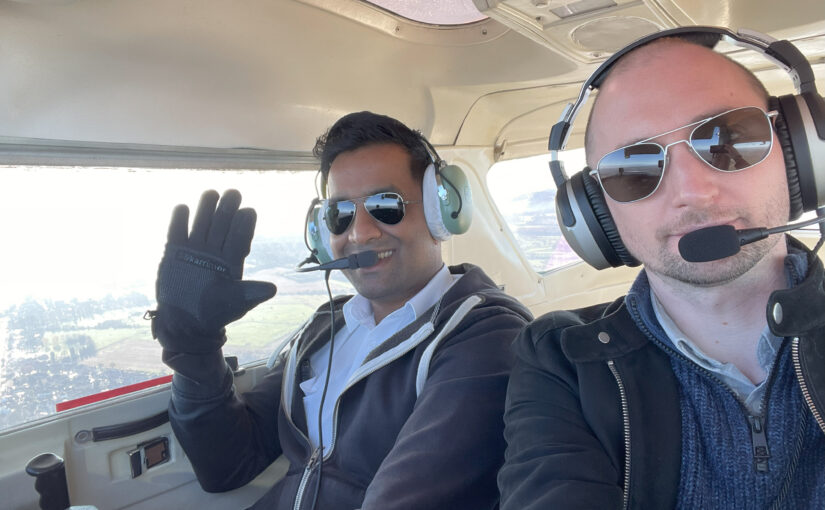
I completed my radio telephony exam yesterday. And that’s the final checkbox. Done. I just need to physically receive my license, and I’ll be allowed to carry passengers. Eep.
Flying, piano, dance, and the big moments.
I completed my radio telephony exam yesterday. And that’s the final checkbox. Done. I just need to physically receive my license, and I’ll be allowed to carry passengers. Eep.

My first public performance in…3.5 years, I think? It went well, though the photos suggest I was not exactly Mr Expressive. Plus ça change. It was a competition, and I came 2 out of 5. Not too shabby. Thank you to @vitawilton for the lovely routine and indeed the entirely delightful Piccadilly Spotlight event.


After 2 years, 64 lessons, a bunch of exams, and a cross-country solo, I passed my Skill Test today. This is the big hurdle before getting a license – it’s pretty much the equivalent of the driving test.
You take an examiner on a flight, and they ask you to navigate and perform various manoeuvres: stalls, recovery from a spiral dive, simulated forced landings, tracking to a VOR, various types of non-simulated landing, and more. It’s quite the day!
I have one more minor box to tick: you need a specific license to broadcast on radio frequencies from a plane, and I need to do a ground-based exam for that. I’ll hopefully get that in the next couple of weeks. And then I’ll have my full license!
Have I mentioned I’m turning 40 this year? I’m turning 40 this year.
I have friends who are sailing through this with nary a breakdown. It is, they say, fine:
All of this is true and indeed wise but, you see, that’s about them and it’s me who’s turning 40. I am.
When I was a kid I read a lot about the history of magic and I learnt that Robert Houdin, the father of modern magic and the magician’s magician, didn’t start until he was 40. I have always remembered this. No matter what happened, I thought, I could always change direction in the far distant future and become the father of modern magic.
But that’s now, guys, it’s now. I don’t even know what needs birthing.
Something needs to happen, though. There is a tickle at the back of my mind that won’t go away. I don’t know what it is yet. But I feel like it’s kicking for the surface.
While I await existential enlightenment, the obvious backup plans are:
Or some combination of the above. I’d better get ready.
After 7 months of lessons, rudely interrupted by lockdowns, I flew solo for the first time this morning. That means: taking off, doing a circuit of the airfield, and landing again – without an instructor beside you. They wish you luck, hop out of the aircraft, and you’re on your own. It’s quite the moment!
I was up half the night worrying, but thankfully it turned out great. Beautiful weather, and a quiet airfield.
It was actually fun. This came as a surprise: I’ve found learning to have a high cognitive load – there’s a lot going on at once, and many things that need to be *just so*. I thought being by myself may make this worse. But today it all felt surprisingly natural. Free and easy. I really enjoyed it.
I’m by no means a licensed pilot yet: this step marks (roughly) the end of learning to fly and the beginning of learning to navigate. I’ve another 6 months or so of lessons, not to mention 6 exams plus the big skills test at the end. So going solo carries no legal weight, but it’s a traditional milestone and a big life goal!
Thanks to all at the excellent Redhill Aviation Flight Training for getting me here.

Little life victory today.
When I was 10 I took grade 3 piano, failed it, and gave up soon after. This annoyed me for 26 years. So at the start of lockdown I signed up for remote lessons.
18 months later and today I passed grade 4. Most pleased.
I got points deducted for playing a baroque piece too romantically. That’s as good an epitaph as any.
Huge thanks to Kensington Piano Lessons for the teaching and encouragement, and for always checking whether it was me or Skype that dropped a note (it was me).

Can you listen to music in your head? I’ve recently discovered I can’t, and it’s intriguing. I know the songs, so I figure I should be able to listen to them whenever I feel like it. It doesn’t work, though. I’ve been trying to catalogue what happens when I try, and here’s what I’ve got so far:
My first approach was to sing along in my head. I don’t actually sing, I just do everything that you normally do when singing – but stop before the actual out-loud noises part. All that matters is the intention to make the same sounds. And this works. I can get through a whole song without much conscious effort. This includes instrumental music – I just sort of sub-vocalise the notes by pretending I’m a violin or whatever.
But this isn’t what I want. It feels different from listening to music. It’s silent singing, rather than listening. I want to instead pull the song from memory and listen to it like it was on the radio, not feel like I am performing it.
So I tried to suppress the active singing. That turned out to be a thing my brain will do if I ask. No talking please, just listening. So this was the second thing I tried. And things happen: I can certainly will music into existence. But when I started paying attention I realised it was…strange. For starters, I don’t ‘hear’ the songs in real-time.
Let’s say I want to listen to ‘It Must Have Been Love’ by Roxette. With no conscious effort I immediately ‘get’ the first line of the chorus. I ‘hear’ the whole thing instantly, even though it would take a few seconds to sing out loud. That’s odd in itself – how is it possible to have a few seconds of music appear in consciousness in a fraction of a second? It’s more like seeing the music than hearing it.
After that the song doesn’t flow like it does when internally singing. I always get it in chunks. And it’ll cheerily just stop. Or sometimes I get a different part of the song – there’s no reliable order to it. It requires a continual low-level mental attention. I have to gently think ahead to the next refrain, and then that too just appears, fully formed. Sometimes I get a whole line or two, and sometimes just a particular musical highlight. But always in these little chunks of compressed time. The more attention you pay, the more structured and ordered it becomes – but the closer it gets to internal singing.
This was a surprise! I had expected that to work. And I thought I could just practice my way around it, but it’s proven quite stubborn.
In a pop-neuroscience way I could hypothesise about neural networks here. If memory is a network of linked ideas, it makes sense that information isn’t naturally ordered. At a low level you just get whatever is most closely connected to the previous part. Maybe the speech centres corral this stuff into a proper order, which is why it works when singing. I’m sure proper neuroscientists could point out 100 ways this is more complicated and interesting.
So, just asking my brain to play music doesn’t seem to work. I have to be actively involved. I can’t passively sit there and listen, with the occasional mental prod. Yet…I do feel like this happens sometimes. When I have an earworm, for example, it just plays unbidden. Admittedly earworms feel more like a glitch than a useful feature. But I also think I sometimes hear music when I’m concentrating deeply. Usually when coding, where it’s easy to fall into cognitive wells. (I’m tempted to say ‘a flow state’, though I’m not sure how dubious that concept is.) I think that songs go around my head during those times, without any cognitive effort. But it’s hard to say for sure: once you snap back to reality everything gets a bit hazy. I certainly can’t trigger this at will, though.
Perhaps relatedly: I’m much more aware of this happening with some visual stuff. When playing the piano I definitely get unexpected visual popups of whatever I’ve been watching of late. I’m not good enough at the piano to be truly zoned out yet, but I’m certainly over the lip of the well. I’m interested to see how this changes.
So that’s my experience, anyway. I wonder if this says something about mental structures in general, or if it’s more about mine in particular.
I’ve always figured that most people’s cognitive mechanisms are roughly the same. The philosophers will talk about the qualia of experience, and how we can never know what it’s like to be another person. But still: the world is real and evolution has adapted us to it. We all have to be able to navigate actual reality. It’s no good if one person perceives the ground differently, or if we all see different colours such that we disagree on, say, their relative brightness. It makes sense to think we have evolved to perceive things pretty much the same way – barring major issues in brain development etc.
But I recently heard the US magician Penn Jillette talk about his lack of visual memory. He can’t picture a scene from different angles, and his dreams are mostly conceptual: he certainly doesn’t seem to dream in the I-am-in-a-real-place way that I do. And while he isn’t entirely face-blind, he remembers few – and those only in familiar conditions. But he has an artist friend whose visual memory is such that she can draw people she hasn’t seen for 20 years. She and he have all sorts of discussions about the differences in their fundamental perceptions of reality, both of which seem entirely natural to them.
(It’s tempting to wonder if it’s a zero-sum game: he remembers most music, which makes little impact on her, and seems to have an almost-visual sense of the structure of ideas. This is likely wishful thinking, though)
This then made me remember an astonishing claim by director Robert Rodriguez. He says that during preproduction on his films he will find out their length by visualizing them while holding a stopwatch. He simply opens his eyes and sees how much time has passed. This is just alien to me. When I try to do that I get the aforementioned chunks problem – everything just turns up in one go. I can’t see how to override that. Maybe it’s something you can practice, but it feels more like a brain-structure superpower.
Maybe Penn Jillette and Robert Rodriguez are just one end of the bell curve, but it made me wonder if I’ve underestimated individual cognitive variation when it comes to these very fundamental perceptions. If there’s major variation amongst the general public about the very nature of perception, it’s no surprise we have so much trouble communicating. I’m sure there’s lot of research on this! I’m looking forward to finding out.
It’s weird finding yourself conscious inside a blob of physical matter. Your internal thoughts seem so freewheeling, but when you poke them a bit you realise they’re clearly running on physical architecture. If my brain can take an input of music from the radio, and just listen, why can’t I turn my memory of that music into an output and listen in the same way? Presumably it’s the same reason my computer “should” be able to do obvious things but can’t. Eventually you learn how everything’s put together and you see it’s a factor of the way it’s built.
I’m interested to know what happens when other people try this. How does your brain differ? Can you hear music in this way?
Photo: “Music Note Bokeh” by all that improbable blue is licensed under CC BY-NC-SA 2.0

We buried my grandmother today. She was a motorbiker, a boater, and a great-grandmother to five. She ran her own clothes shop, officiated at TT Races for decades, and she and my grandfather were a year away from their 70th wedding anniversary. She will be missed.
The funeral was as good as such a thing can be. I have some contacts in this area. As it happens, today is the 125th anniversary of Humanists UK, where come Monday I’ll have been working for 10 years. I have spent much of that time supporting our network of humanist celebrants. I’ve got to know many of them, and I’ve worked with some of the most knowledgeable people in the funeral trade. So I was very lucky that the plans for today were informed by the best in the business – thank you so much, to those reading – and I knew the celebrant who led the service.
He did an excellent job. It was dignified, thoughtful, caring, and told the complete story of her life. A real tribute. It was hard, but it was a proper moment in time.
My grandmother was, we think, happy. She had love, and her family around her. She and my grandfather endured tough times – indeed, life-changing times – but always together. She seemed, broadly and as much as you can say this about another person, content. Her final years were more difficult, and not a little cruel, as illness took its toll. But she had a good life, and lived it well. Her family are a testament to that.
She had a soft spot for Mickey Mouse, and a good collection of Mickey memorabilia. I used to pick her up a different item on my every trip to Disneyland. But over the last year she’d grown particularly fond of a giant toy octopus – bright orange, with the happiest smile you’ve ever seen. It was this that sat on top of her coffin today. It was quite the sight. She’d have loved it.
She used to take me shopping when I was little. I think she bought me my first magic trick. I will treasure the idyll of watching cartoons at her house on a Saturday morning, usually a family dog or cat nearby, while she made my lunch. And I’ll forever be reminded of her by the taste of pear drops, which she always had to hand for me and my sister. We gave out free bags as the mourners left.
My old dance studio, Karen Hardy Studios, closed down this week. It had been trying to change form for a while, but couldn’t survive 2020.
It was a lovely, complicated place. As with any dance studio it had its fair share of politics, drama, and occasional creepy men. It sometimes muddied the idea of being glamorous with being elite. And the prices could be eye-watering.
But it wasn’t cynical. Karen herself was charismatic, skilled, and put the effort into knowing you. The staff poured their heart and soul into their work. The students had goals, workplans, written histories, and a solid idea of what they were working towards and why. The management continually developed and iterated new ideas, honing in on what worked (big Christmas parties, internal progress medals, almost-daily communications) and what didn’t (Sunday evening social dances, website member areas, complex lesson packages). The events were huge, star-studded, and lingered long in the memory. The studio building had a bar and lounge for chatting long after your lesson had finished, which *I actually did*, and encouraged you to call in when passing. It was a good setup.
And it was great at lifting me out of the world. For a couple of hours a week I was looked after, taught a skill and encouraged – in a little land of sparkles and catharsis. No matter what else was happening in my life, I walked in and felt better. And the ultimate otherworldly experiences were the international dancing competitions. These were whirlwinds of light and terror and camaraderie. I still get a contented glow thinking about them – particularly the Disney trips.
The world of competitive dancing is, like any other niche, full of tradition and social mores that have evolved and tessellated over the decades. It is often charming (infectious enthusiasm for *everything*), regularly idiosyncratic (let’s merge the bronze and gold level couples), and sometimes downright weird (international competition compères). It is regularly confusing even for people who know what they’re doing. At the top level it is run by competing cartels who will have nothing to do with each other, but who control their own domains by a mixture of rules, grandiosity, appeals to tradition, dubious claims to authority, and ever-so-polite ostracism. The big competitions have the not-entirely-unreasonable but not-entirely-reconcilable dual aims of calibrating dance skill while bringing in as much money as possible. The venues are full of competitors who have been dancing since they were 4, know the industry inside out, and who don’t really know what to say to a bunch of amateurs from London there for the teacher/student competitions.
The studio did a good job of filtering out this oddness. We pretty much sailed through it all on a wave of glitter, fear, and punch-drunk elation. Dance. Wait. Cheer. Check timings. Dance. Explore. Did I eat? Eat. Dance. Check timings. Console. Cheer. Food? Check timings. Somehow late. Run. Watch the superhuman professionals. Sleep. Repeat. All while looked after by the ever-excellent teachers.
I was always far more nervous about the social aspects than the dancing, but those competitions gave me huge (and much-needed) boosts in social confidence. Despite my being a bit weird and a lot quiet, I made friends who I would help move mountains to this day. (You weren’t allowed to be proper friends with the teachers or staff, though. You can see the theoretical reasons for this. Thankfully this worked fine and never caused any problems.)
It was a good few years. Ultimately I left the studio and discovered the wider London dance scene. But I fondly remember my time there, and I’m sad it’s gone.
Thank you to all the teachers and staff who ran the place. You were and are appreciated! You did a good thing.